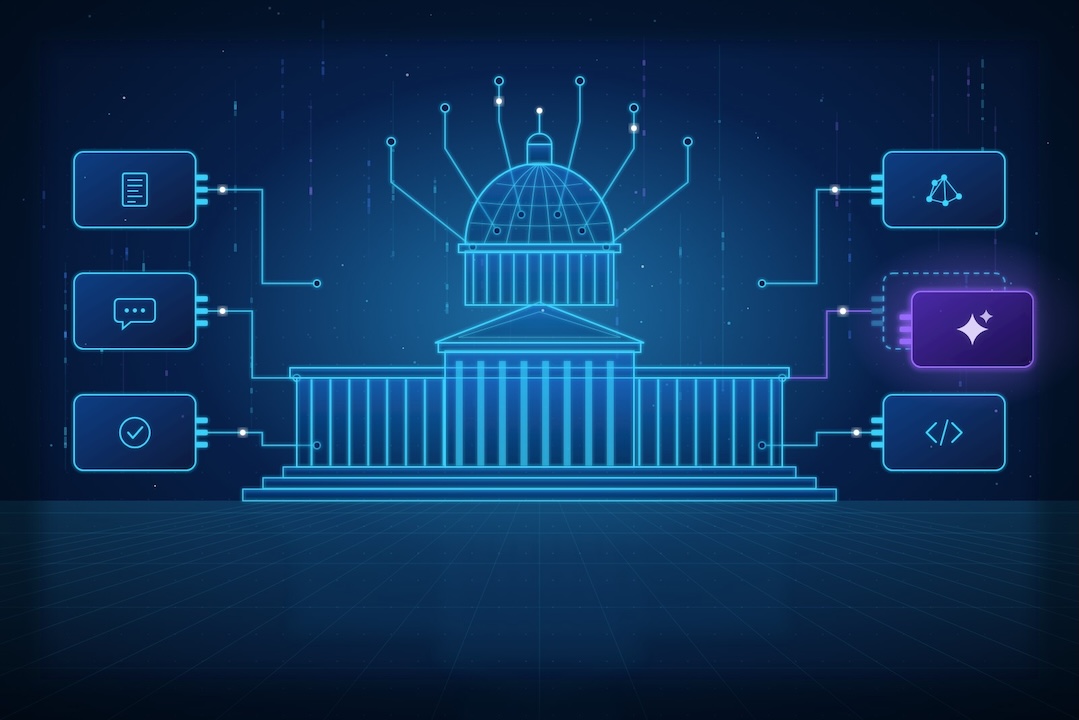
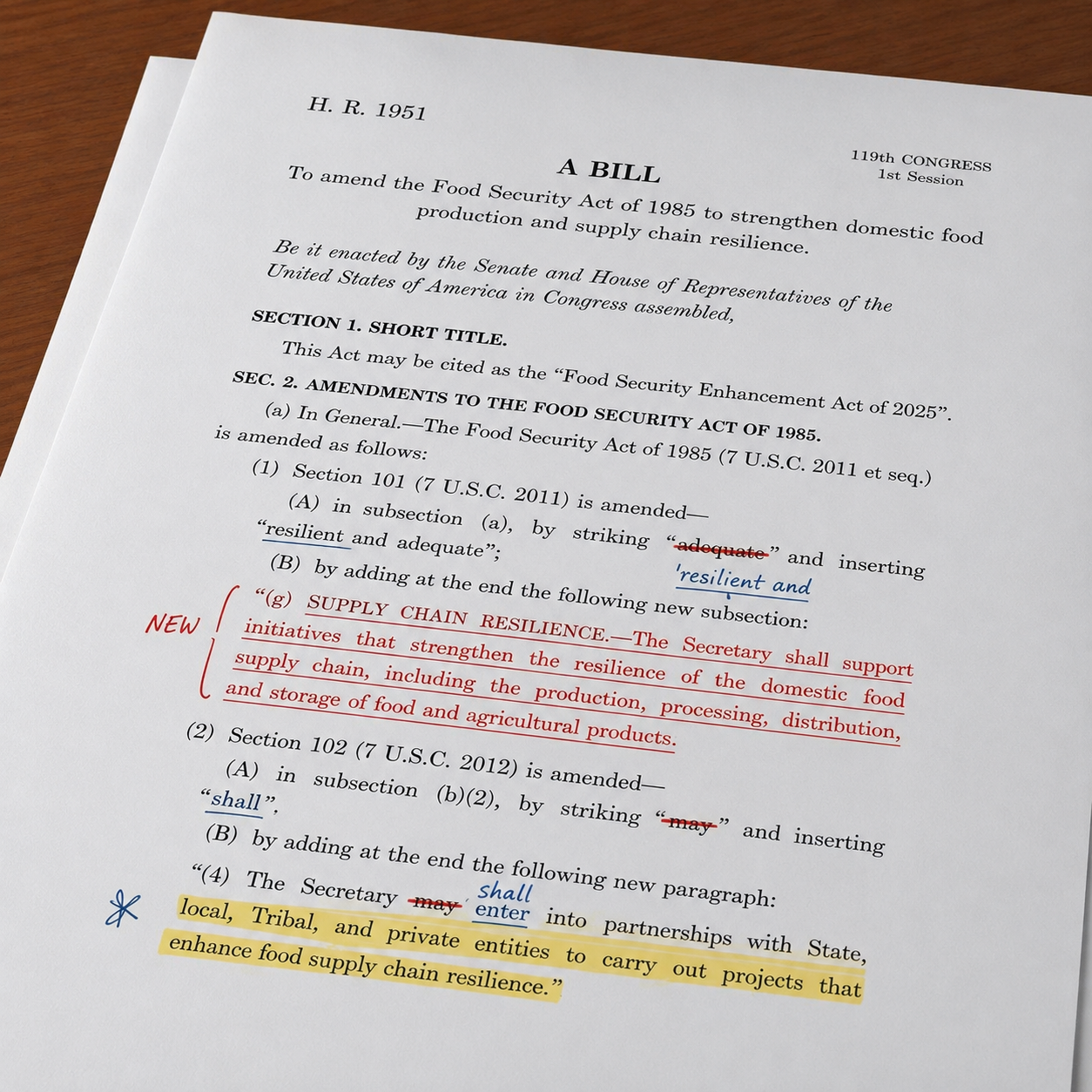
Blueprint for Publishing Legislative Information in the Era of AI
September 30, 2026

New Problem
Legislative information has always been published for the human reader. Today humans are gather this information indirectly through AI, so the methods we use to publish must change.
New Solution
Grant Vergotinni (CEO of Xcential) presented the solution to 30+ parliaments on September 22, 2026 in Washington, DC.
Xcential regularly presents at Bussola Tech events, where global parliamentary leadership gathers to explore modernization and AI.
We hope you found this presentation valuable.
------------------------
Transcription
Below is a transcription of the presentation (created using AI).
Publishing Legislative Information in the Era of AI
Grant Vergottini, CEO, Xcential Legislative Technologies. Presented at the 6th LegisForum, U.S. Capitol, Washington, D.C., September 22, 2026.
Introduction (0:00)
My name is Grant Vergottini. I am the CEO of Xcential Legislative Technologies. Today I'm going to provide a blueprint for publishing legislative information in the era of AI. This is a presentation I gave at the 6th LegisForum at the U.S. Capitol in Washington, D.C., on September 22, 2026.
The DIKW Pyramid (0:25)
I'm going to start, as I often do, by introducing the DIKW pyramid. This is a well-established conceptual model that describes how raw facts are connected to become information, which is understood to become knowledge, and which with use becomes wisdom. Understanding this plays an important role in understanding how AI fits in.
Documents in a legislative system exist at different levels. Many documents, like PDF files, Word documents and plain text files, are disconnected. They are closer to being simple data files. Sophisticated files are connected and semantic, usually XML files such as USLM at the U.S. federal government or Akoma Ntoso in other jurisdictions.
Artificial intelligence operates above data and information, at the knowledge and wisdom levels, but it relies on good-quality information and data below it. An AI system fills in gaps where data and information are missing, and that is where AI hallucinates and suffers other problems.
Official, Authentic and Authoritative (1:36)
Another thing we need to understand is the difference between official, authentic and authoritative. These words are often used interchangeably, but they don't mean the same thing. Also, these words aren't mutually exclusive. A file can be all of these things at the same time.
Official means that the file is from the true source.
Authentic means that the file is guaranteed not to have been tampered with, using digital signatures and encryption technologies. It turns out that AI doesn't care about authenticity. It just doesn't have the bandwidth to validate it.
Authoritative means that the document comes from a trusted source and its contents can be considered true, but not necessarily official.
In this example relating to healthcare law, we have the official text on the left, and authoritative annotations on the right, connected loosely by page location to unofficial text. The problem is that the authoritative annotations on the right aren't connected in any way to the official text on the left.
Where Legislative Information Lives (2:49)
Information and data are everywhere. A lot of it is available in the cloud, but elsewhere as well. The quality of that information can vary significantly, and some of it, unfortunately, is misinformation. Some information is authoritative but not official. Whether or not information is official, some of it is public and some of it is internal, and it is likely all poorly connected.
Some official documents may be stored in an information-rich XML format, such as USLM in the federal government and Akoma Ntoso elsewhere. These can contain vast amounts of rich information, including text and metadata.
Behind the Firewall (3:38)
But this information can be vulnerable if not protected, so firewalls are put in place to protect it. As a result, the information behind the firewall goes dark. It's hidden from the world.
Portals: PDF and HTML Files (3:52)
To make this information visible to the human world, in a controlled way at least, portals are created and information is published through them. But while a rich set of information exists behind the firewall, what gets published to the world is often dumbed down for consumption by humans alone. According to the DIKW pyramid, PDF files, HTML files and similar files are transformations of the original information, but they often lack the richness of the original source.
To make things worse, login forms are added to secure the portal, and query forms are added to help people locate the information they want. In the end, these lock the information away from search engines and AI training engines.
How AI Training Works (4:46)
When an AI model is trained, it does so by accessing a vast amount of responsive, static information. While it will hopefully filter out misinformation, it will also filter out any information that isn't easy to access or digest.
If the information source isn't responsive, it will be ignored. If a login is required to access the information, it will be ignored. If a form has to be filled out to query the information, it will be ignored.
The AI-Ready Portal (5:18)
Without responsive access to official information, AI training will simply find other sources for that information, authoritative or maybe not. What is needed is a responsive portal targeted specifically at AI training engines.
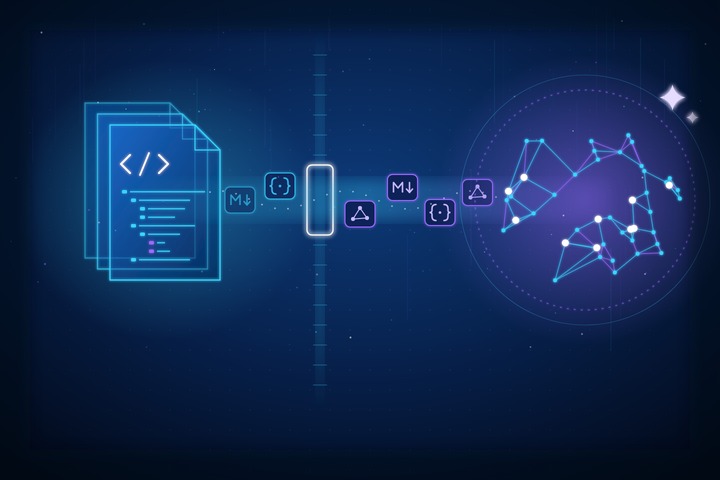
Just as a human-centered portal transforms rich internal information formats into human-consumable formats, the AI-ready portal should publish the rich information in formats that AI training engines can easily ingest: Markdown files, JSON files, citation graphs and the like.
The LLM Is Not the Same as AI (5:56)
The result of AI training, ingesting a vast amount of static data and information, is the large language model, or LLM.
AI and the LLM are not synonyms. The LLM is one part of an AI chatbot or AI agent. It's a very important part: it gives the AI engine its thinking system for understanding our world. But it is not perfect.
We all have an LLM in our human brains. We have all learned spelling, grammar, mathematics, science, history, geography and so on. But our recall is imperfect. We all make mistakes. Our knowledge gets dated. We even sometimes make up answers without knowing it. If we were an AI chatbot, we would say we hallucinate all the time.
AI isn't a human brain, and it works quite differently. AI works using mathematical statistics rather than the emotions, experiences and prior knowledge that we use. But although it works quite differently, it has some of the same weaknesses as the human brain.
AI Consults Too: MCP Servers (7:21)
As humans, we are all fallible. We know that, so we consult when it matters. We go to libraries, read textbooks and search the internet for accurate and current facts. And we use tools to do tasks we couldn't otherwise do, or couldn't do as well.
Now AI can do this too, using MCP servers. MCP stands for Model Context Protocol. It is a way for an AI chatbot to consult information sources in real time. It lets an AI chatbot explore current information through lookups and queries, and it lets an AI chatbot or agent perform tasks.
It is crucial to understand how this works. MCP servers are not used for the AI training that produces an LLM, and the information retrieved through an MCP server is not fed back into the LLM. The LLM is static. Once created, it isn't updated. A new version of an LLM might be created at a later date, but an existing one isn't modified.
MCP servers are attached to the AI chatbot. You can manually attach an MCP server to access your own information, which means the MCP server can be an internal resource within the firewall. There are many use cases for this. For instance, you could use an MCP server to create a conversational interface for controlling a workflow within the organization.
Security and Confidentiality (9:02)
At this point, you should start worrying about security. Perhaps this hasn't all been thought through yet. Is an MCP server creating a security hole through the firewall? Let's think about this some more before going too far.
Legislative drafting offices have a lot of confidential information flying about. Legislative drafts are usually subject to attorney-client privilege. Even within the organization, much information is privileged and restricted to certain individuals. Before going too far, guardrails must be put in place to protect confidentiality and other sensitive assets.
Vendor Data Retention and ZDR (9:50)
There is something called vendor data retention. When you have a conversation with a chatbot, that conversation is being logged. The chatbot won't immediately learn anything from your conversation; you don't have to worry about that. What you do need to worry about is that the conversation might be used to train a future version of the LLM. You need to check the small print.
Part of the solution is something called zero data retention, or ZDR. ZDR is a pledge, of sorts, not to store or log your conversations with the chatbot. Unfortunately, getting ZDR in place is neither affordable nor easy.
Skills (10:37)
One more thing: skills. We all learn skills over the course of our lives. We might become painters. Not me, but some people. We might learn to play the piano. Again, not me.
Now AI can learn skills too. You might create a skill to convert a complex document or complete some other complex task.
So what are skills? Skills are reusable, replayable sequences of prompts. They are written as simple Markdown text in a skill file. They can be created from an AI chat, they can be parameterized, and they can be very powerful.
Conclusion (11:27)
In conclusion, AI today is not just LLMs. LLMs provide the background knowledge that gives AI its understanding. But for AI to work properly, it also needs access to real-time information, and it needs tools. MCP servers provide that access. They must be designed to be useful, and they must be secure and confidential.
Finally, AI can now also learn skills: reusable capabilities that can be strung together to perform tasks. Perhaps they can be used to make drafting more efficient. Check out my blog on that subject.
Thank you. If you have any questions or comments, please reach out to me at grant@xcential.com.